


The World Cup Was Not A Win For Most Cities: Fans Filled Stadiums, Not Hotel Rooms
KEY POINTS
- Most World Cup host cities recorded lower hotel occupancy than a year earlier.
- Match-day spikes in occupancy failed to translate into sustained demand.
- Some cities spend more on providing services in support of the games than they take in as tax revenue.
The 2026 World Cup was supposed to deliver one of the biggest tourism windfalls in sports history.
“When FIFA first came out and said, you know, this is going to be eight Super Bowls, we host Super Bowls. And, you know, I think we pretty much realized that it wasn’t going to be like eight Super Bowls, especially the first couple of weeks,” William Pate, president and CEO of Atlanta Convention and Visitors Bureau, told Atlanta WSB-TV’s Michael Doudna.
Statistics from the bureau indicate that hotel occupancy rates in Atlanta spiked to 80% on some nights like during the Saudi Arabia-Spain match but generally hovered around or below 60%, a 12% decline from the same time last year according to data from real estate information company CoStar.
Atlanta’s experience was not an outlier.
CoStar noted that, “despite hosting a combined seven World Cup matches, Atlanta, Seattle and Kansas City experienced a combined 13.5% decline in hotel demand and an 11.2-percentage-point drop in occupancy” compared to 2025.
Costar Group
In fact, of the 11 U.S. World Cup host cities only San Francisco and Dallas recorded net hotel occupancy increases year over year at a time when the national rate overall increased by 2.4%.
So more visitors were checking into American hotels on average, except in most World Cup host cities which saw fewer bookings. The biggest declines were in Kansas City (24%), Seattle (15%), and Atlanta (13%).
World Cup hotel occupancy rates dipped north and south of the U.S. border as well, with the three Mexican host cities—Guadalajara, Mexico City, and Monterrey—posting lower occupancy metrics along with their Canadian counterparts, Toronto and Vancouver, down 12.4% and 20.9%, respectively, for the week ended on June 20 CoStar data showed.
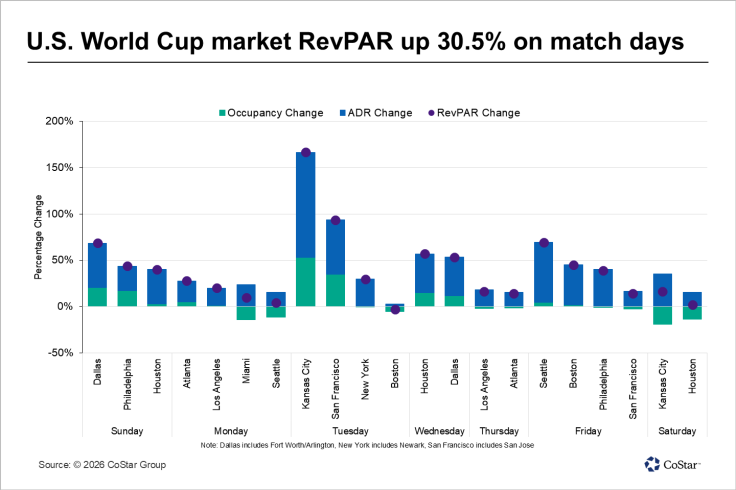
In some weeks, match-driven hotel occupancy growth reached positive territory compared to last year for Dallas and Monterrey but most cities failed to break even or exhibited uneven surges like Kansas City, Atlanta, and San Francisco.
CoStar Group
The overall picture that emerges from hotel occupancy data indicates that most World Cup host cities had fewer visitors than last year most of the time, match-driven spikes notwithstanding. The declines are particularly notable because there was no broader slowdown in travel overall, at least in the U.S.
Rather than adding tens of thousands of new tourists to annual visitor inflows, World Cup host cities inadvertently may have altered the behavior of people and businesses who would have otherwise visited but instead chose to avoid service disruptions and higher-than-normal hotel prices brought on by the world’s most popular tournament.
San Francisco seems to have avoided this conundrum by hosting no less than three AI-related business conferences as well as the 2026 Pokémon World Championships during the games while Dallas’ hotel occupancy numbers were likely padded by hosting the FIFA International Broadcast Center which served as the logistical and broadcast hub for all 104 matches of the tournament.
Researchers and academics who have studied the economic impact on cities that host large, one-time events would not be surprised by the experience of World Cup host cities because it largely corroborates existing datasets on the topic.
Economists Robert Baade and Victor Matheson examined the 1994 World Cup and found that hosting matches failed to deliver the expected economic benefits for host cities. A more recent 2022 study of 43 Olympic Games and World Cups co-authored by academics Martin Müller, David Gogishvili, and Sven Daniel Wolfe found that more than 80% of them cost more to put on than they generated in economic revenue.
New York City is a perfect example of this phenomenon, with the Comptroller’s office projecting that the city will spend $70 million on providing security and other services while generating only $55 million in additional tax revenue at best.
Hosting the World Cup is a great way to put a city into the global spotlight but the evidence suggests it is not often a winning economic strategy.
