


Survey Reveals Corporate America’s AI Divide: Performative Adopters vs. Value Creators
KEY POINTS
- While 75% of C-suite executives admit their AI strategy is “more for show,” a smaller group of companies is driving real business outcomes.
- AI adoption is increasingly concentrated in areas like coding, customer support and enterprise search, where companies can more easily track productivity gains.
Corporate America has spent the past two years racing to deploy generative artificial intelligence, but the results have been anything but uniform.
A growing body of executive surveys suggests many organizations are struggling to translate AI spending into measurable business value. At the same time, a minority of companies are focusing their AI adoption efforts narrowly on solving clearly defined problems and developing performance metrics that can help them measure return on investment.
Working with the independent research firm Workplace Intelligence, the generative AI company Writer conducted a survey of 1,200 non-technical employees actively using AI at work as well as 1,200 C-suite executives. A large majority of companies (59%) said they were spending $1 million a year on AI. Unsurprisingly, AI use was found to be ubiquitous:
- 97% of executives say their company deployed AI agents in the past year, with 52% of employees already using them.
- 94% of the C-suite and 70% of employees use AI tools for at least 30 minutes daily, with 64% of executives spending two hours or more.
However, widespread use of AI did not necessarily translate into positive business outcomes:
- 75% of C-suite executives said their company’s AI strategy was “more for show” than practical operational guidance.
- 48% of executives described their organization’s AI rollout as a disappointment.
- 39% of companies reported having no formal strategy to monetize their AI investments.
- Only 29% of organizations said they were seeing significant returns from generative AI.
There were also some alarming findings, including:
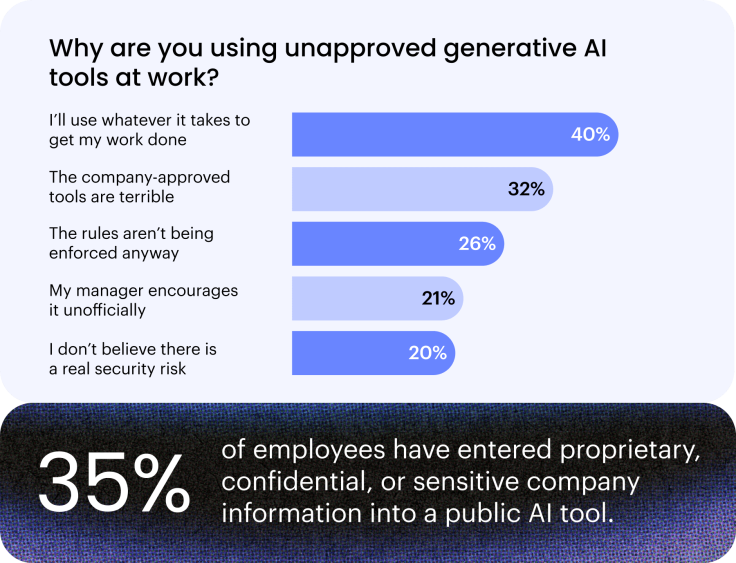
- 67% of executives think their company has already suffered a data leak or security breach because an employee used an unapproved AI tool.
- 35% of employees have input proprietary information into a public AI tool.
- 55% describe AI use as a “chaotic free-for-all” at their company.
- 36% of companies lack a formal plan for supervising their agentic AI and 35% could not immediately “pull the plug” on a malfunctioning AI agent.
- 73% of CEOs report AI-related stress or anxiety and 64% fear losing their jobs over AI transition failures.
- 69% of companies are planning AI-driven layoffs, yet 39% lack a strategy to drive revenue from AI tools.
- 29% of employees (and 44% of Gen Z) said they sabotaged their company’s AI strategy.
Driven by pressure from investors, boards and the rapid pace of AI adoption across industries and consumer households, many businesses rolled out AI initiatives and measured success by number of licenses issued or employee token usage. The survey results suggest this approach may have produced unintended consequences, including greater use of unauthorized AI tools, security breaches and employee resistance.
Writer
Writer
Yet enterprise AI adoption is far from stalling. According to research from venture capital firm Andreessen Horowitz (a16z), 29% of Fortune 500 companies and 19% of Global 2000 companies are already paying customers of leading AI startups, suggesting enterprise demand is increasingly concentrating around production-ready software rather than experimental pilot programs.
The AI implementations producing the strongest business outcomes tend to share a common set of characteristics. Based on AI startup revenue data, a16z found that successful enterprise adoption is clustered around a relatively small number of functions and industries where results are easier to measure. Coding remains the dominant use case by a wide margin, followed by support and enterprise search, while technology, legal, and healthcare businesses have emerged as the sectors most eager to adopt AI.
The common denominator across these use cases is that the work tends to be text-heavy, repetitive, and relatively easy to verify, making it well suited to AI assistance.
Businesses that began AI projects with narrowly defined workflows and established performance metrics were more likely to generate measurable returns on investment. By contrast, organizations attempting company-wide transformations before establishing governance, workflow boundaries, and clear success metrics were more likely to report disappointing results and operational disruption.
As enterprise AI spending rises, the price of performative adoption may soon become too high to ignore. Companies that rushed to deploy AI without first determining where the technology could create measurable business value may eventually be forced to answer the question they avoided from the beginning of the AI revolution: where can AI actually deliver a measurable return?
