


Singapore to prioritise high-value AI infrastructure as Asean markets play to their strengths: Tan Kiat How
[SINGAPORE] Singapore will focus on maximising the value of its artificial intelligence infrastructure rather than simply maximising computing capacity, as South-east Asian markets play to their respective strengths, said Senior Minister of State for Digital Development and Information Tan Kiat How.
“Our ambition is not maximum compute; it is maximum value from compute,” he said in his keynote address at the Asia-Pacific Finance Forum on Wednesday (Sep 23).
He said the future of AI infrastructure in South-east Asia would be regional, rather than having each country to provide the entire ecosystem.
“The AI infrastructure race will not be won by megawatts alone. It will be won by how well we connect compute, energy networks, capital and businesses.”
He added that not every workload needed to sit in Singapore, with Asean as a whole being able to offer the full infrastructure proposition the AI economy needs.
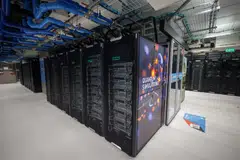
Singapore currently hosts more than one gigawatt of data centre capacity, but faces constraints on power, land and water.
“No single country needs to provide all of it. Some markets will contribute energy and space, while others demand talent and industrial capability,” said Tan.
“Our opportunity is to connect these strengths into a regional system that is more valuable than the sum of its parts.”
Singapore as a regional anchor
He said that within the region, Singapore can help make the system “more connected, investable and trusted”, citing the forthcoming Digital Infrastructure Bill (DIB) as an example.
The Bill, tabled on Sep 8 and expected to pass Parliament in October following a public consultation in July, seeks to strengthen the security and resilience of major cloud services and data centres.
Tan noted that the Bill reflects a proactive approach to sustaining digital growth while giving society confidence in its underlying infrastructure by achieving three core objectives.
“First, it establishes clear security and precedence requirements for our largest data centres and cloud providers,” he said.
“Second, it creates a sustainability baseline so that as compute grows, land, power and water are used more efficiently.”
“Third, (it creates a framework under which) companies make material green strategic or economic commitments to secure the scarce resources and scarce capacity,” he added.
Sustainability is key
Stronger security, resilience and sustainability requirements support long-term digital growth while giving long-term investors greater certainty, noted Tan.
“Around the world, we see data centres becoming more politically salient. Questions are being asked about electricity, water, land, grid capacity and what communities receive in return,” said Tan.
Singapore aims to avoid false trade-offs by addressing these challenges early, he added.
He noted that the city-state has collaborated with industry players on energy efficiency, tropical data centre standards, cooling technologies, resilience and security.
“(Singapore has) also introduced competitive exercises for new data centre capacity to ensure that scarce resources go to projects offering strong sustainability and broader economic value,” he added.
“Resilience is not simply a regulatory requirement – it is part of the economic infrastructure that allows businesses to digitise with confidence,” he said.
“The same is true of sustainability,” he noted. “(It) is not about slowing digital growth; it is what gives us the headroom for disciplined growth.”
