Singapore takes ‘prosper thy neighbour’ approach to Asean energy trade: Tan See Leng
Regional electricity trade and fuel stockpiles are key areas for future development, says minister
[SINGAPORE] Far from a zero-sum game, Asean energy cooperation could bring hundreds of billions of dollars of investments into South-east Asia, said Singapore’s Minister for Energy, Trade and Industry (Energy and Industry) Tan See Leng.
“The uplifting of the local domestic economies cannot be understated… and our philosophy has always been ‘prosper thy neighbour’,” he told the media at a press conference in mid-November, ahead of the 49th Asean Summit.
He said he would do his best to articulate this vision and have “as wide an audience” as possible to get them to see the merits during Singapore’s term as Asean chair in 2027.
“The key is unlocking the political willpower to do this, because many of (the projects) require investments that run into decades,” he said in embargoed remarks.
“It’s how we articulate that vision, socialise the vision across all of the different governments and the people, to get them to believe in this vision.”
Cross-border trade
Speaking at his first sit-down press conference since the Ministry of Trade and Industry was renamed the Ministry of Energy, Trade and Industry (METI) on Oct 1, Dr Tan noted that countries have to prioritise their domestic energy needs
But he added that “it is really not a zero-sum game; it doesn’t mean that, if you work with your neighbours… your domestic needs will be compromised”.
Instead, regional energy trade offers economies of scale and scope that, when coupled with a credible and transparent regulatory framework, can “crowd in significant capital”, he said.
He added that the multidirectional nature of connectivity would enable countries that export energy to also become importers.
SEE ALSO
He was responding to a question on whether plans for clean energy exports from Indonesia to Singapore could fall through. Indonesian Energy and Mineral Resources Minister Bahlil Lahadalia had said on Nov 2 that Indonesia would not export electricity to Singapore “if the price is not right”.
Dr Tan’s latest remarks came shortly before Asean released an enhanced memorandum of understanding (MOU) on the Asean Power Grid (APG) regional energy trade project.
First proposed in 1997, the APG aims to link member states’ individual electricity grids through overland and undersea interconnectors by 2045.
Largely stalled for decades, the APG has seen a revival of interest amid surging energy demand and supply disruptions caused by military conflict between the US and Iran.
Given the geographical proximity among the Asean states, the set-up of a regional grid “makes perfect commercial sense”, Dr Tan said.
He cited “a lot of interest” in the APG from investors such as the World Bank, the Asian Development Bank, sovereign wealth funds, Japanese banking consortiums and parties from the Gulf Cooperation Council countries.
“You are looking at at least hundreds of billions, if not at least a couple of trillion, potential investments opening up and coming into Asean, and this is how exciting it can be,” he said.
But even with the signing of the enhanced MOU, Dr Tan said more work is still needed on a regulatory framework that addresses the laying, access, maintenance, repair and overhaul of submarine power cables.
More clarity is also needed on renewable energy certificates (RECs) – market-based instruments originating from clean-energy projects such as solar and wind farms – which can be purchased to offset electricity consumption from fossil fuels.
Matters to be resolved include tracking the award of RECs and the obligations of member countries in selling and purchasing these instruments.
Regional stockpiling
Beyond cross-border electricity trading, another key matter of regional cooperation is the possibility of an Asean oil stockpile, which the bloc discussed in May. The prospect is now the subject of “active discussions”, Dr Tan said.
He noted that Singapore is part of the Asean Petroleum Security Agreement (Apsa), a petroleum-sharing scheme to mitigate energy crises, which was set up in 1986 and updated in 2025 to include natural gas.
The latest agreement has not yet been fully ratified by all Asean members, with Prime Minister Lawrence Wong calling for this to be done “swiftly”.
In the interim, news of other oil-sharing partnerships has emerged.
The Philippines’ national oil company PNOC Exploration Corp signed letters of intent on Nov 13 with companies in Indonesia and Thailand for a proposed pilot that would allow the Philippines to tap these neighbours’ oil reserves in an emergency.
When asked whether Singapore would make its own push for a regional stockpile, he said it would be a question of how the city-state can work with fellow Asean members and “how we can achieve economies of scale”.
The objective is “a true win-win-win partnership and not having (a) separate kind of stockpile”, Dr Tan said, while adding that factors such as the location and size of a stockpile would have to be worked out.
Separately, Philippine media reported after Dr Tan’s press conference that Singapore, Indonesia, Malaysia and the Philippines would participate in a regional oil stockpiling initiative with the United Arab Emirates.
In response to queries from The Business Times, a spokesperson for METI said Singapore has not made any commitment to participate in the proposed regional oil stockpiling arrangement.
Still, Singapore “supports efforts to strengthen regional energy security and resilience” and “is keen to explore practical areas of cooperation” with Asean and other partners, including on information-sharing and capacity-building for potential stockpiling, the spokesperson added.
Singapore’s future energy mix
In the long run, some 40 per cent of Singapore’s energy could come from cross-border electricity trading, alongside alternative sources such as green ammonia or hydrogen.
When asked, Dr Tan said that Singapore’s future energy supply would probably continue to be underpinned by gas, though the fossil fuel’s share of the energy mix could fall to about half by 2050, from 95 per cent now.
He expects natural gas to serve as a “baseload” source of energy, even in the transition to renewables: “Come what may, you burn, there’s still energy being generated. And hence you cannot completely diversify away from gas.”
Asked whether the Republic would still be able to meet its target of being net-zero by 2050 with that level of reliance on natural gas, he expressed optimism that decarbonisation would be possible if 40 to 50 per cent of the energy mix is from clean or renewable sources.
“No country in the world can go 100 per cent green,” he said.
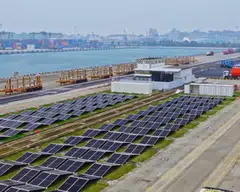
Meanwhile, solar power could account for about 10 per cent of Singapore’s energy mix in the long term. Dr Tan, noting the “aggressive ramp-up” of domestic solar installations, pointed out that the accompanying battery-energy storage systems have large land requirements. The land-scarce island’s high cloud cover also limits the amount of solar power that can be deployed.
Nuclear energy remains in the running as another potential substitute for gas as a baseload, thanks to the energy density of nuclear fuel.
“We are scrutinising every single development in the nuclear-energy space very carefully,” said Dr Tan, naming the future commercial viability of small modular reactors as a key threshold to meet.