


Oil prices continue climb on US-Iran deal doubts; stocks retreat
Uncertainty over the global inflation outlook weighs with the Strait of Hormuz set to potentially stay close
Published Wed, Aug 12, 2026 · 06:47 AM
[NEW YORK/LONDON] Oil prices touched a one-week high on Tuesday (Aug 11) and Wall Street finished lower as traders grew more pessimistic about a potential deal to bring stability to the Middle East and reopen the Strait of Hormuz.
Uncertainty over the global inflation outlook also weighed.
Gold prices retreated from a two-month peak ahead of consumer price data due on Wednesday.
The Strait of Hormuz will remain closed as long as the US does not change its behaviour and accept Iran’s conditions to end the war, the newly-appointed secretary of Iran’s Supreme National Security Council said on Tuesday.
“Markets are grappling with the prospects of some form of detente, although they’re misguided in thinking that any form of resolution is the last chapter of this story,” said Ron Albahary, chief investment officer at LNW.
World equities gave back earlier gains, with MSCI’s gauge of stocks across the globe down 0.23 per cent.
A back-and-forth between the US and Iran has been in focus amid escalating tensions that sent oil prices surging 5 per cent on Monday.
US President Donald Trump on Monday had responded to Iranian conditions for a deal with his own, calling for Iran to pay compensation for those killed in wars, attacks and protests, potentially complicating efforts to reopen the crucial waterway.
Brent futures rose US$1.19, or 1.4 per cent, to settle at US$88.91 a barrel, as US crude finished up US$1.07, or 1.3 per cent, at US$83.20.
“This is going to be almost a war of attrition now,” said Tony Sycamore, a market analyst at IG. “You probably can see the (oil) market sitting around the US$75 to US$95 range while we wait to see who blinks first.”
On Wall Street, the Dow Jones Industrial Average fell 0.34 per cent to 53,791.85, the S&P 500 lost 0.32 per cent to 7,728.20 and the Nasdaq Composite declined 0.60 per cent to 26,445.45.
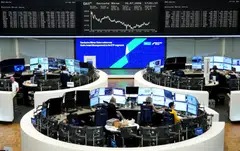
The pan-European Stoxx 600 was flat at 660.51 points, holding near all-time highs as investors balanced earnings optimism against geopolitical risks in the Middle East.
Emerging market stocks fell 0.28 per cent to 1,665.44. MSCI’s broadest index of Asia-Pacific shares outside Japan closed flat at 1,627.53.
Inflation data
While Wednesday’s US July consumer price report will not capture the most recent rise in energy costs, it could still prove instrumental in setting expectations for September’s US Federal Reserve meeting, for which money markets show there is a 50-50 chance of a hike.
“We think the risks are skewed towards a hot print, which would probably drive a rebound in rate expectations and, potentially, renewed worries about stagflation,” said Jonas Goltermann, chief markets economist at Capital Economics.
The yield on benchmark US 10-year notes fell 0.35 basis points to 4.695 per cent.
Tech stocks in focus
The Nasdaq was down about 2 per cent from a record high close touched in early June. Amazon and Alphabet each fell, weighing on the tech-heavy index and the S&P 500.
Overnight, Nvidia said it had teamed up with six major financial institutions, including BlackRock, Apollo and Goldman Sachs to create a set of funding measures worth more than US$500 billion for artificial intelligence infrastructure.
It did not disclose much more detail, such as financial terms, investment commitments or how the planned US$500 billion might fit into existing funding deals.
“A small part of me was left wondering whether this is how it felt when subprime mortgages first became a mainstream product – the innovation that eventually helped trigger the GFC,” Sycamore added, referring to the global financial crisis.
Intel raised US$20 billion through a share sale, the first offering of its stock since the chipmaker listed in 1971.
Currency gyrations
Among currencies, the yen was back in the spotlight. It last was up 0.01 per cent against the US dollar, remaining off last week’s high of 155.20 after several suspected rounds of intervention, including a joint move by Japan and the US.
A holiday in Japan made for thinner trading than usual – often seen as a possible catalyst for intervention, as smaller trades can have a greater price impact than in normal conditions.
The dollar index, which measures the greenback against a basket of currencies, including the yen and the euro, rose 0.05 per cent to 99.82, with the euro down 0.01 per cent at US$1.1541.
Spot gold fell 0.45 per cent to US$4,368.61 an ounce, while US gold futures finished up 0.5 per cent at US$4,441.10. REUTERS
