How China created a spy network in California. ‘They will try anything’
Over the last half a century, Chinese spies have taken aim at a wide swath of California targets.
They have worked as a Boeing aerospace engineer and a naval engineer at defense contractor Power Paragon to obtain highly classified information on U.S. space shuttle and Navy projects. They have assumed the roles of electrical engineering professor at UCLA and software engineer at Google and even worked as a driver and aide to the late U.S. Sen. Dianne Feinstein when she chaired the Senate Intelligence Committee.
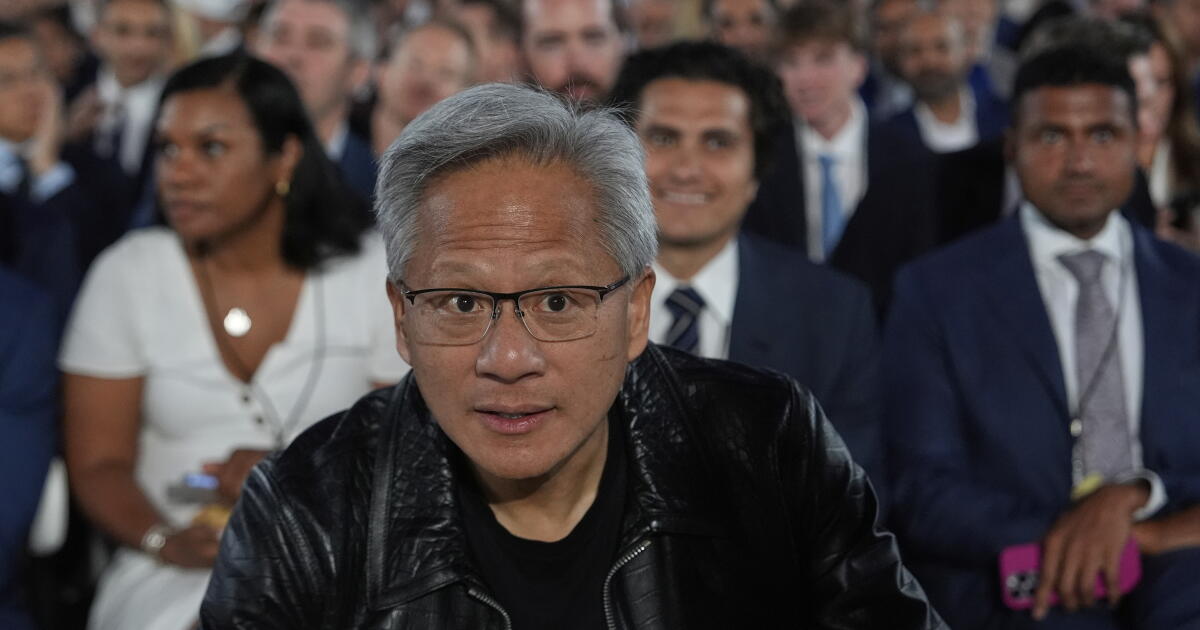
Intelligence experts say that China continues to ramp up its network of spies and assets across California, as underscored this week after Nvidia Chief Executive Jensen Huang admitted he was embroiled in an extramarital affair when allegations surfaced that he had a relationship with a suspected Chinese spy.
“For years, the FBI has been sounding the alarm regarding China’s ambitious efforts to gain technological, economic and geopolitical superiority,” said former Assistant Chief Horace Frank of the Los Angeles Police Department, who oversaw intelligence. “Their activities constitute a long-term strategic threat — not only to the United States, but to the world. Their counterintelligence strategy is not only about stealing secrets today; it’s about securing strategic advantages tomorrow. They recognize that human vulnerabilities (sex, money, ego and ambition) can be crucial when it comes to them attaining this quest for global dominance.”
For China, California is a key espionage hub because it combines three attractive targets: advanced technology industries, major research universities and a large concentration of scientists, engineers and entrepreneurs, according to William Hannas, lead analyst at Georgetown’s Center for Security and Emerging Technology. China’s main objectives are to accelerate its technological development, reduce dependence on foreign suppliers and achieve leadership in strategically important fields, including artificial intelligence, Hannas said.
“Silicon Valley is especially important,” he said, “because it offers access not only to existing technologies, but also to innovations at their earliest stages.”
California is also a focal point of China’s espionage efforts, some experts say, because it has the highest number of Chinese residents in the continental U.S.
“It has been easier for both the spies and agents of influence to hide in plain sight, because they can more easily integrate themselves into their communities compared to places with a lower proportion of Asian Americans and Chinese residing overseas,” said Victor Shih, director of the 21st Century China Center at the UC San Diego School of Global Policy and Strategy.
Walking a fine line
For the U.S., Shih said, guarding against Chinese spies involves a delicate balance.
Officials must avoid politicizing the issue in such a way that they cast suspicion on Chinese scientists or Asian Americans based on race and ethnicity.
Already, many Chinese people working for California companies feel like they are being targeted, he said, and some complain the
suspicion means they are passed over for promotions. And there have been high-profile cases of Asian Americans unfairly accused of spying.
“Corporations need to put a lot of race and nationality neutral policies in place to secure their property rights,” Shih said. “Things were way too lax before, but now we’re running the risk of a witch hunt. The worst thing that could happen, and is somewhat happening now, is that a witch hunt in the U.S. drives many otherwise totally innocent scientists to China, and ends up helping China to develop technologies that one day will replace U.S. technology or even challenge U.S. military superiority.”
A race for technology leadership
Beijing’s leaders are seeking to catch up with — and eventually surpass — the U.S. in the frontier spheres of defense, aerospace and technology. Increasingly, China is also positioning assets in California to launch cyberhacking attacks and seek political influence and spread propaganda, intelligence experts said.
“They will try anything,” said retired FBI Supervisory Special Agent James Gaylord said of China’s Ministry of State Security, the nation’s principal civilian intelligence and security service.
Gaylord, who led multiple counterintelligence operations in California, said Chinese spies and agents are everywhere in the state, infiltrating private companies and even government offices.
“Unlike the Russians, the Chinese favor a shotgun approach,” he said. “‘A thousand grains of sands’ is how they refer to it.”
In addition to cultivating relationships with California’s technology CEOs to secure direct insights into U.S. artificial intelligence policies, China’s spies are also logging on to social media to try to cultivate relationships with students at top research institutions such as Stanford University.
As some spies adopt the ancient espionage practice of honey potting, using sexual or romantic allure to extract sensitive information, Gaylord frequently delivers a blunt warning to California’s tech bosses.
“If you’ve got access to technology, if you’re a billionaire and a 50-year-old balding man, and you’ve got a 25-year-old woman thinking you’re hilarious and the most interesting thing, it’s not you,” he tells them. “It is what you have access to.”
Chinese spies have embarked on affairs with high-level California politicians. According to declassified FBI interviews, disgraced former U.S. Rep. Eric Swalwell told investigators in 2015 that he had sexual relations a handful of times with Christine Fang, a suspected Chinese spy.
They have also compromised U.S. counterintelligence. In 2001, the FBI opened an inquiry after receiving credible information that Katrina Leung, a San Marino businesswoman it recruited as an informant in the early 1980s, was actively working as a double agent for China. It discovered that Leung, whose code name was “Parlor Maid,” was in a sexual relationship with her agency handler of 18 years, FBI Supervisory Special Agent James J. Smith, and had an affair with William Cleveland, another FBI agent. It also found that, over the years, FBI officials had learned of several incidents indicating that Leung provided classified U.S. government information to China.
Leung was charged in 2003 with obtaining, copying and retaining national security documents, but the U.S. government ultimately blocked the defense from talking to a key witness: her former FBI supervisor, Smith. After pleading guilty to lesser charges, Leung avoided a stiff prison sentence. She and Smith now live together, according to public records, in a $1.4-million San Leandro home in Alameda County.
A long history of spycraft
According to Hannas, China’s foreign technology acquisition program dates to the 1950s. Initially, the focus was on obtaining specific military technologies and components. Then, it expanded to manufacturing processes, advanced commercial technologies and, eventually, the underlying science from which new technologies emerge.
“The methods expanded accordingly, from conventional espionage and technology purchases to cyber operations, academic collaborations, talent recruitment, overseas investments, and systematic exploitation of publicly available research,” Hannas said. “The objective evolved from acquiring particular products to acquiring the capacity to innovate.”
One of the earliest documented occurrences of Chinese espionage in California occurred in 1979, the year Beijing and Washington set aside their differences and established full diplomatic relations.
According to the Department of Justice, Dongfan “Greg” Chung, a Chinese-born aerospace engineer who worked on NASA’s space shuttle program in Downey, sent a technology professor in China three sets of classified documents by sea freight. He then wrote to the professor to ask what else he could do for his homeland.
About 27 years later, FBI officials searching Chung’s home found more than 250,000 pages of documents containing decades’ worth of sensitive trade secrets that Chung had shared with China, including stress analysis reports and design information for the space shuttle, B-1 bomber engineering manuals, and plans for the fueling system of a Delta IV rocket.
Chung was convicted of economic espionage and acting as an agent of China in 2009. The following year, he was sentenced to nearly 16 years in prison.
Investigators found out about Chung when they were investigating Chi Mak, a Chinese-born electrical engineer who orchestrated one of the most notorious family-run espionage rings.
A devout Maoist who worked for Power Paragon, Mak allowed China to make 20-year leaps in technology, said Gaylord, who led the landmark counterintelligence investigation. Mak gave China the Quiet Electric Drive to subdue the sound of submarine propulsion, the advance combat system called AEGIS, and the Electromagnetic Aircraft Launch System allowing jets to carry heavier payloads off aircraft carriers that is now on China’s fleet. In 2008, he was sentenced to more than 24 years in prison.
The convictions of Chung didn’t stop China.
In 2020, a former USC professor, Hao Zhang, was sentenced to 18 months in federal prison for conspiring to steal smartphone signal technology. In 2024, former U.S. Navy sailor Wenheng Zhao received 27 months in prison for delivering military operation details to a Chinese intelligence officer. In January, Jinchao Wei, a former sailor on the USS Essex in San Diego, was sentenced to more than 16 years for espionage after taking bribes for photos and documents.
China tends to have a different relationship with its spies than nations such as Russia.
In addition to using highly trained Ministry of State Security agents, Shih said, it relies on a much larger number of amateurs and ordinary Chinese people to assist with technology acquisition, political influence and harassment of dissidents — and it doesn’t care what happens to them.
“In the Cold War, they used to say, ‘I got one of your guys, you got one of my guys, we’ll trade,’” Shih said. “The Chinese government has never tried to get any of these people back. It’s like, well, if you get caught, you go to jail. That’s it. Too bad.”