


Geopolitical risks must be considered before investing in tech: Temasek chairman Teo Chee Hean
One has to take into account global events and how that may impact a company, says the chairman
[SINGAPORE] While Temasek Holdings is “quite forward-leaning” when it comes to its investments in technology, the many geopolitical risks facing the world today are top of mind before any major decision is made.
Teo Chee Hean, the former Cabinet minister who became chairman of the Singapore investment company in October last year, pointed out that technology sectors have become “quite sensitive” when it comes to investment.
“Those who have the technology or resources want to keep them and use them as leverage. And so, investment is no longer a straightforward business of doing the numbers on a spreadsheet and analysing just the economic cycles and the financial situation of a company,” he said in an interview with local media.
“One has to take into account the geopolitical events that are happening and how that may impact the company. And some of them can happen quite suddenly and have a major impact.”
He stressed the importance of having to judge the geopolitical risks carefully as “we do not want to be caught making an investment (where) the circumstances in which we made the investment change fundamentally”.
AI is “a real game changer”
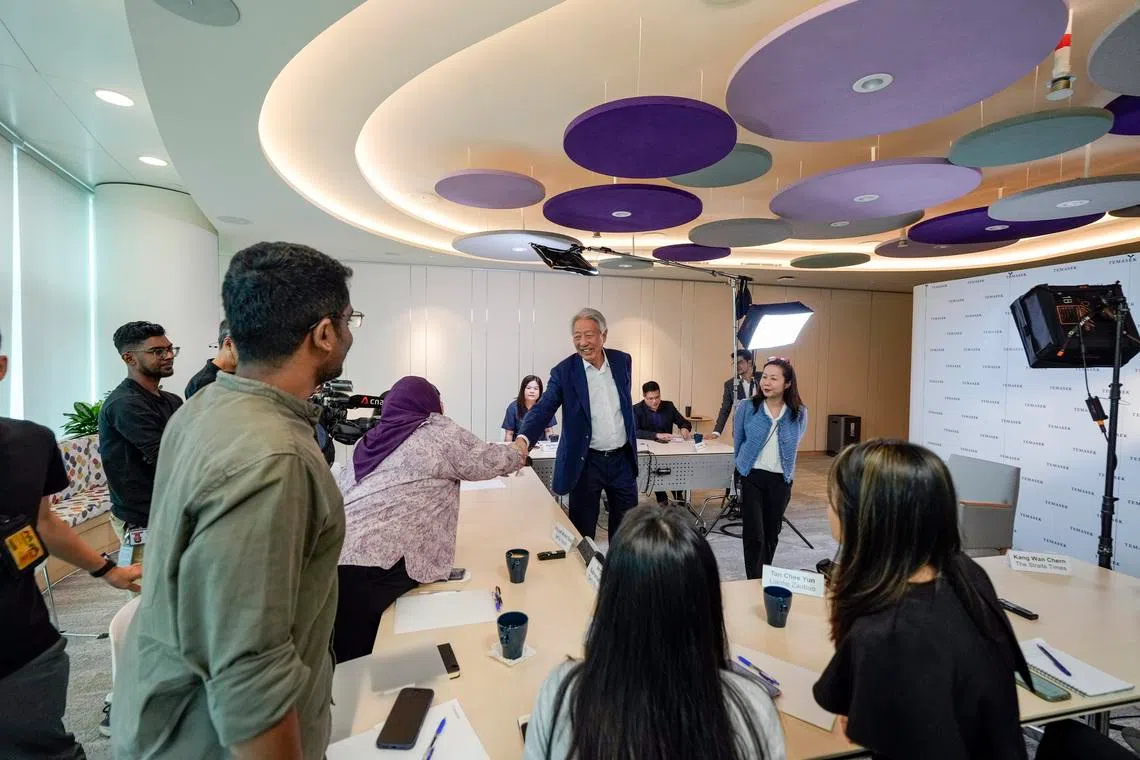
The 71-year-old was giving his first full interview since he joined Temasek’s board as deputy chairman in July. He succeeded Lim Boon Heng to become the company’s fifth chairman three months later.
Teo, a former senior minister and coordinating minister for national security, retired from politics after 33 years of service in April last year, just before the general election.
The topic of artificial intelligence and technology came up frequently during the lively hour-long interview at Temasek’s office along Orchard Road.
AI is going to be a “real game changer” that is poised to create an entirely new sector of growth that will sweep across many industries, said Teo.
He pointed out that AI is “quite different” from earlier trends like blockchain because of its applicability and the way it will change how business is done and how companies are organised.
“Just like how we had Internet-native companies which came out of nowhere and became very large companies, we will have AI-native companies which (will also) come out of nowhere and create new lines of businesses and services which they can provide,” he said.
Giving an insight into the company’s thought process before backing AI companies, Teo said the investments are in firms that are “not just developing LLMs (large language models)”.
“We also look for companies which – from their market positioning and from the way they are able to use AI creatively in that market segment – are able to create value and they will disrupt others,” he said.
“We try to avoid those who will be disrupted. So this is one way in which we look at technology investments, not purely on the technology side but also the entire range of companies.”
Beyond the prominent players that are developing LLMs, Temasek also remains keen on companies that are providing hardware and power.
“There’s a rather large stack there in which you can invest meaningfully, and in a way which may not get so caught up in the geopolitical arguments,” he added.
Great ferment in drug discovery
Besides the digital economy and AI, Teo said that secular trends such as healthcare and longevity are not going to change anytime soon, and these are also areas that Temasek has been investing in and will continue to do so.
He cited India as an example of a country that has growing domestic demand for good healthcare. “We have invested in that space, and one of the companies that we have invested in is going to (launch its) IPO (initial public offering) soon,” said Teo.
He also shared that Temasek was looking closely at drug development and drug discovery. Teo said he visited some companies in China and Switzerland to learn more, given that there is a “huge demand” in the world for more effective and better drugs.
“There is a great ferment in drug discovery. Some of that is driven by AI as well, but also by new discoveries in the way drugs work,” he said.
He talked about his visit to a well-known Swiss drug company that is using AI to aid them in their drug discovery, such as the identification of diseases and the design of the drugs.
“They have 100 years’ worth of data and they are ingesting it into their system. Most of that data is, by nature of the drug industry, things that did not work or come to the point where it produced an efficacious and safe drug,” said Teo.
“But that is very valuable data because it helps them to identify which drugs are not likely to work so they do not have to spend money and resources and time on those. So this is one example and we look for insights like these to invest in the various companies.”
Fallout from Gulf conflict
This interview took place on Tuesday (Jun 2), two days after Singapore hosted the annual Shangri-La Dialogue, which featured ministerial and defence delegates from over 40 countries including the US and China.
Teo, a former defence and home affairs minister, also attended that annual security forum where the ongoing Middle East conflict was among the many pressing global issues that were discussed at length throughout the three-day conference.
“We are seeing the first-order impact of what is happening in the Gulf crisis, and that is energy. Energy prices have spiked. There are countries which can afford to pay those prices, so they still have access,” he said, adding that this will have an impact on inflation, growth and costs.
The second-order impact is on areas such as food prices, which brings about a secondary effect because of higher fertiliser prices and other related costs, he said.
“These things will come to impact the world economy in the next phase. I expect that the ‘tail’ from whatever happens in the Gulf war will not be something which will end immediately when the shooting stops and the Strait of Hormuz opens, but it will be with us for a while.”
While Temasek’s portfolio companies are active in the Middle East, Teo said that their presence there is not sizeable though still significant.
He said that Temasek sees “continued prospects” in the Gulf and the Middle East as it is a growing region.
“There has been a disruption in the stability which they have enjoyed for some decades now. But they have a lot of resources, high ambitions and, increasingly, a high ability to see through these ambitions,” he said.
“This is something which we believe our portfolio companies and our direct investments will be able to contribute to and benefit from. We are looking carefully at what we can do there, and we are prepared to step in when the opportunities arise.”
Decoding Asia newsletter: your guide to navigating Asia in a new global order. Sign up here to get Decoding Asia newsletter. Delivered to your inbox. Free.
