From oil rigs to offshore wind: Singapore yards chase Europe’s energy-transition business
Singapore is repurposing expertise built over decades serving the largest offshore oil and gas companies for the energy transition
Published Sun, Oct 25, 2026 · 11:32 AM
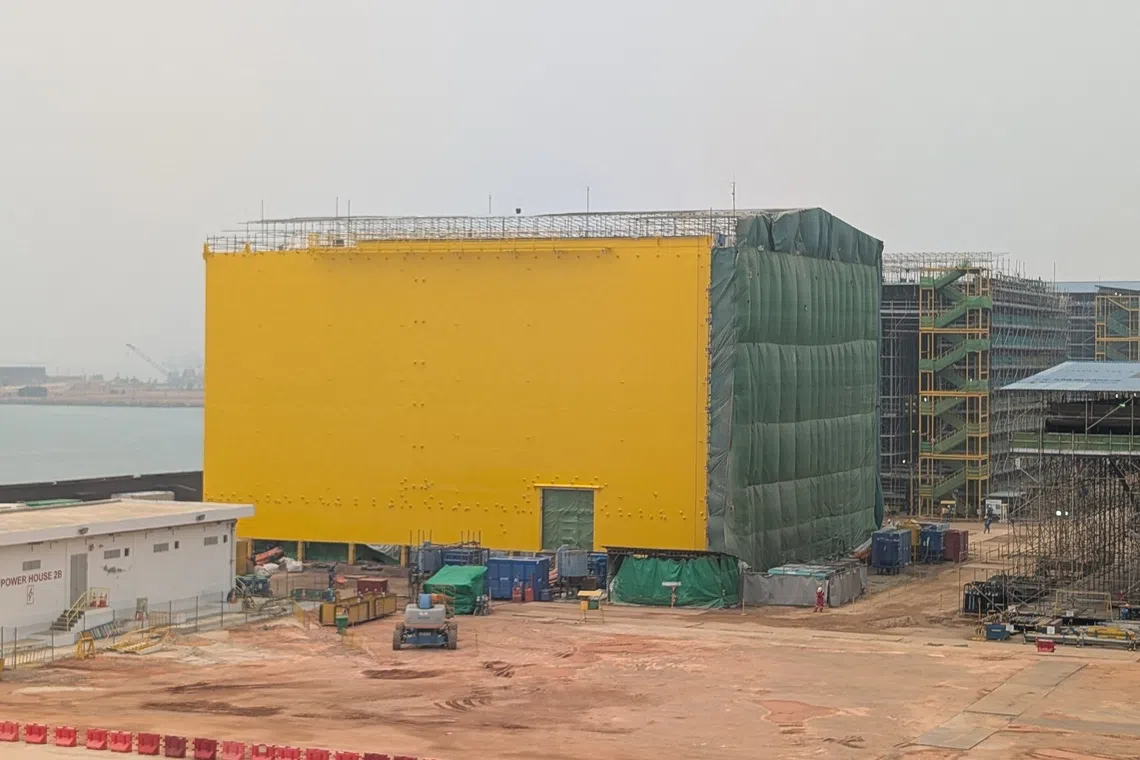
AT A shipyard in northern Singapore, a yellow platform towers over a maze of scaffolding and cranes. Resembling a 15-storey building, the piece will be shipped halfway around the world to Europe to be installed into an offshore wind farm.
The 30,000-tonne platform, known as a high-voltage direct current converter, is scheduled to leave Seatrium ’s yard for the North Sea in 2028, where it will sit 60 km offshore and help transmit electricity generated by wind turbines back to land. It’s the latest effort by Singapore to tap into Europe’s green push.
Singapore is repurposing expertise built over decades serving the largest offshore oil and gas companies for the energy transition. One of the biggest opportunities is exporting these enormous converters – known as HVDC platforms – to Europe, where the technology is widely used to transmit offshore wind power over long distances.
The specialised technology is one bright spot in an otherwise battered offshore wind industry. Investment plummeted 72 per cent year-on-year globally to about US$12 billion in the first half of 2026, according to BloombergNEF (BNEF). Yet few yards have the expertise and capacity to build the platforms, threatening a supply bottleneck as the European Union pushes ahead with plans to expand capacity.
Seatrium’s platforms, each designed to handle about 2 gigawatts (GW) of electricity, are the largest of their kind in the world. It takes five years to construct one platform, which will operate for 40 years. GE Vernova supplies the HVDC technology in the platforms.
The city-state and nearby islands now account for up to 20 per cent of global capacity outside of China for the platforms, according to Ember analyst Lam Pham, up from a negligible share just a few years ago. Demand is poised to rise as Europe builds wind farms further out to sea, giving the region’s shipyards an opportunity to capture more of the business.
“The country has invested, the company has invested – and this is a showcase of what is possible,” said Chris Ong, chief executive officer of Seatrium.
Seatrium, which is partly owned by Singapore investment company Temasek, was tapped by European grid operator TenneT Holding to build four platforms for North Sea clusters. About 7,000 workers will build the structures at yards in Singapore and Batam, an Indonesian island that is 50 minutes away by ferry. Each platform, along with connecting infrastructure, costs as much as 5 billion euros (US$5.6 billion) each, according to TenneT.
Such platforms will be critical to unlocking growth in the global offshore wind industry, which faces challenges including high costs, supply chain shortages and regulatory hurdles.
Despite these hurdles, Europe is still pressing ahead with a massive expansion of offshore wind to meet ambitious green energy goals. The UK awarded a record 8.2 GW of capacity in its latest subsidy auction, while Germany and the Netherlands are implementing new revenue-protection mechanisms. With enough state support, BNEF expects installations to double by the end of the decade, led by China, UK and Germany.
Singapore is now trying to position itself as the top choice for European developers. Rival yards in the Middle East are upended by the regional conflict; China and South Korea are mostly meeting domestic demand; and Europe’s shipyards are being taken up for building defence-related vessels.
“Singapore would make it cheaper, even including the higher shipping costs, because the industry is very labour-intensive and labour costs in Europe are super high,” said Ember’s Lam.
While wind turbines generate alternating current electricity, offshore developers use HVDC platforms to convert that power to direct current, allowing it to travel longer distances with less energy loss along the way. This will become a growing trend as wind farms move further from crowded shores.
Ong – who was CEO of oil rig-builder Keppel Offshore & Marine before it was merged with Sembcorp Marine to form Seatrium in 2023 – is hoping to capitalise on offshore wind demand over the next two years. The company was chasing S$9 billion (US$7 billion) worth of HVDC and HVAC projects across Europe and Asia Pacific as of July. Clean energy-related contracts currently make up about 40 per cent of the company’s order book.
In the yard in Singapore, the future of offshore wind power is slowly taking shape, with welders hunched over steel panels, piecing together the massive yellow structure one module at a time. For Ong, the demand for this infrastructure is not only being driven by the energy transition – it is part of Europe’s effort to secure future power supply.
“The scale and the massive need for offshore wind is a big security drive,” he said. “It has to happen.” BLOOMBERG