


Why Home Cooking Still Lacks Precision and What Real Temperature Monitoring Could Change
Modern home kitchens often appear technologically advanced, powered by digital displays, convection fans, app connectivity, and algorithm-driven presets that can give the illusion of control and consistency. Yet a fundamental question remains largely unanswered: why does home cooking still rely on approximation rather than precise measurement?
Many at-home cooking appliances can regulate air temperature, but food temperature remains subject to inherent cooking instincts or guesswork. That distinction may seem minor, but it defines the difference between consistent outcomes and under- or overcooked meals. Proteins do not always respond to heat in predictable ways, as some forms expand and others contract. They are influenced by collagen fibers, moisture loss, fat-rendering, and microbial-kill thresholds. All of these factors are governed by internal temperature, which isn’t determined by the number displayed on oven panels.
The continued absence of real-time internal temperature data can validate why smart kitchens may still not produce consistent results. That blind spot has remained unexplored in appliance design for decades, as timers may substitute sensors, and presets may replace cooking decisions. Visual cues can stand in for the lack of temperature data. The question worth asking is whether the problem lies with cooking or with the tools themselves.
Typhur enters that conversation as a technical response to that blind spot. Its Sync Oven and Sync Air Fryer are built around the premise that cooking should be controlled by internal food temperature. In doing so, it challenges the notion that airflow optimization and surface heat are true measures of doneness.
In professional kitchens, internal temperature monitoring can be non-negotiable. Wireless probes and instant-read thermometers may guide decisions at every stage. At home, however, temperature sensing is often optional. Wired probes may limit movement, and standalone thermometers could interrupt workflow. Many air fryers and ovens lack proper probe accommodation, all of which could elicit a disconnect between professional standards and consumer tools.
Typhur’s approach integrates a wireless probe directly into the cooking system. The company emphasizes that the Sync Air Fryer’s five-point sensor array is designed to measure internal temperature with ±0.5°F accuracy so it can capture thermal gradients that single-point probes may miss. Furthermore, the oven closes the loop by automatically stopping the cooking process when the target temperature is reached. This can provide control for home chefs, who may otherwise hover around to avoid overcooked meals.
When chicken breasts become overcooked on the surface before reaching internal equilibrium, salmon dries out, or steaks miss doneness due to carryover cooking miscalculations, the significance of internal temperature and sensing failures becomes glaring. Typhur’s system addresses this by anchoring its technology to internal thresholds.
The Sync Oven extends this logic further through thermal efficiency. According to Typhur, its 360° Turbo Convection System, powered by dual heating elements, is designed to reduce cook times by up to 30%. Faster cooking is not inherently better, but faster controlled cooking has the potential to reduce moisture loss and improve texture.
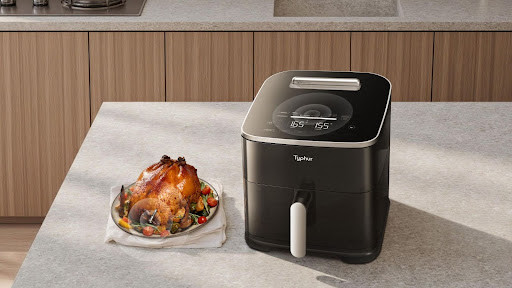
Still, automation in cooking raises its own questions. Does removing manual judgment diminish skill? Or does it allow cooks to focus on flavor development and ingredient quality rather than damage control? “Historically, precision tools, from sous vide circulators to induction cooktops, have supported the expansion of culinary capability rather than replacing it. Typhur’s systems follow that lineage by standardizing the variables that matter most,” says Allen Fung, Managing Director of Typhur.
The design choices reinforce Fung’s philosophy. The ceramic nonstick basket, magnetic probe storage, and dishwasher-safe components suggest an emphasis on repeat use. Additionally, its probes, structured to offer extended battery life, are aimed at reducing friction and making data-driven cooking a default behavior with consistent results.
In doing so, Typhur opens a broader conversation on what “smart” should mean in a home kitchen. If appliances can monitor internal food conditions with accuracy, why should consumers accept outcomes based on timers and guesswork? And if professional-grade temperature control is feasible at a consumer level, why has it taken this long to become integrated?
Typhur’s Sync Oven and Sync Air Fryer illustrate a shift toward precision-based cooking and propose a technically grounded alternative, where doneness can be verified. And in that process, it offers a recalibration of expectations around what precision and control should mean in the future of home cooking, where outcomes are measured, not predicted.
