


Travel chaos worsens as Iran conflict shuts key Middle East airports
The extensive suspension of all air services will severely disrupt the finely-tuned choreography of global aircraft movements
Published Mon, Mar 2, 2026 · 12:03 PM
[DUBAI] Travel chaos extended through the Middle East and beyond, sending airline stocks sharply lower on Monday (Mar 2), as carriers across the Persian Gulf extended blanket flight suspensions, causing major disruptions at some of the world’s busiest airports.
Emirates, the world’s largest international airline, halted all operations to and from Dubai until 3 pm local time on Monday and warned of disruptions till Thursday. Etihad Airways extended cancellations until 2 pm on Monday, while Qatar Airways said flights to and from Doha were suspended due to the closure of Qatari airspace.
The disruptions rippled across Asia, with Cathay Pacific Airways cancelling some services to the Middle East through Mar 5. In India, IndiGo’s flight suspensions extended till Tuesday.
US President Donald Trump said that the bombing campaign against Iran would continue until its objectives were achieved, sending airline stock lowers as investors digested the impact of axed flights, airspace closures and lengthy travel disruptions.
Cathay fell as much as 7 per cent at the open in Hong Kong, while Singapore Airlines dropped as much as 7.5 per cent. Qantas Airways lost as much as 10 per cent.
The United Arab Emirates’ civil aviation authority said that it tended to more than 20,000 affected passengers caught up in the disruption. Tens of thousands of people have been stranded in a region that functions as a global superconnector, linking any two points on the planet with one single stop.
Navigate Asia in
a new global order
Get the insights delivered to your inbox.
Several airports in the Gulf were hit in the crossfire as Iran sent missiles and drones across the region in response to the initial attack on Saturday by Israeli and US aerial forces.
Abu Dhabi Airport said that one person died and several were injured overnight after the emirate intercepted an Iranian drone. Dubai’s main airport, the world’s busiest international hub, reported damage to a concourse that injured four staff members.
Bahrain’s main airport was targeted by a drone overnight that left damage. Kuwait’s airport was also struck by a drone and a number of employees sustained minor injuries.
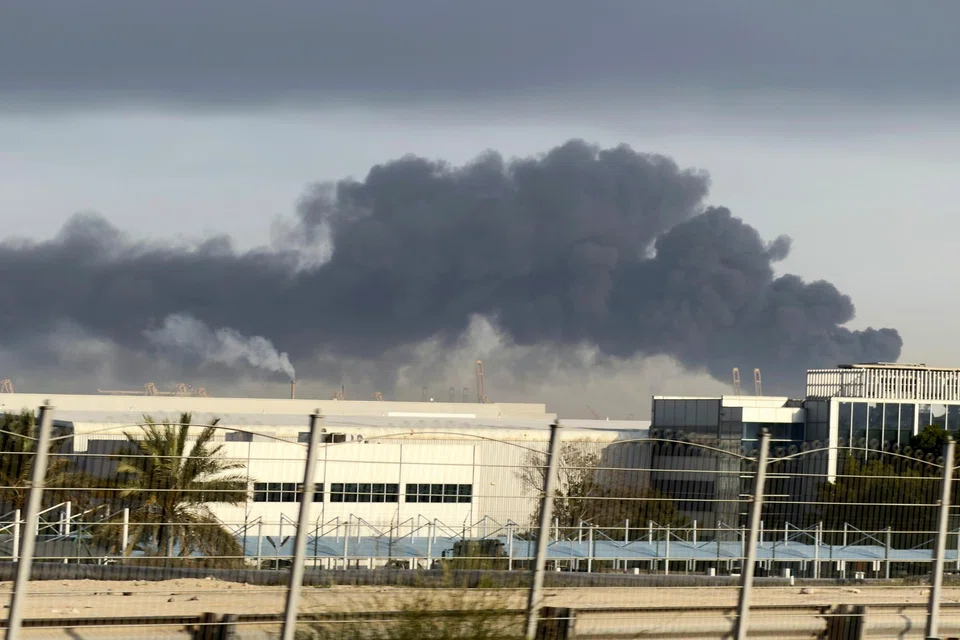
Though the Persian Gulf has become accustomed to disruptions as the skies over large swaths of the Middle East suffered restrictions several times during the past two years, an outright suspension for many hours on a massive scale is unprecedented. The situation highlights the stakes in the conflict that’s pitting Iran against Israel and the US and has destabilised the energy-rich region.
The extensive suspension of all air services will severely disrupt the finely-tuned choreography of global aircraft movements. Already, many planes and crew are out of position because of the airspace closure, meaning that it will likely take days to work through the backlog even once operations resume.
Elsewhere, India’s civil aviation authority said that local carriers cancelled 410 flights on Saturday and 444 are expected to be cancelled on Sunday. Airlines around the world, from Canada to Europe to Singapore, all said that they have suspended their services to the Middle East.
Emirates, Qatar Airways and Etihad have spent decades building up massive fleets that funnel passengers through their hubs, turning the Middle East into a vital artery for global air-traffic flows. The airlines have become a main driver for growth in the Gulf, as they shift from being transfer facilitators to bringing business and tourism into the region. BLOOMBERG
Decoding Asia newsletter: your guide to navigating Asia in a new global order. Sign up here to get Decoding Asia newsletter. Delivered to your inbox. Free.
