


SGX stocks that survived the market sell-off
Some stand to benefit from the conflict, while others have fundamentals too strong to suppress
[SINGAPORE] Stock markets around the world have been pummelled since war broke out in Iran on the last day of February, with the Singapore Exchange (SGX) being no exception.
Aviation was an example, with many airline stocks getting hit. On the other hand, some energy stocks soared, with oil spiking past US$100 per barrel in the past week. Investor sentiment has grown cautious, with the Cboe Volatility Index, known as the Vix, surging about 28 per cent since.
In Singapore, the Straits Times Index has dropped about 2.8 per cent as at Thursday (Mar 12), with most stocks across the broader market in the red.
Even for counters with market values at S$100 million and above, only 59 out of 269 gained. Among them, only 15 posted increases greater than 5 per cent.
Some of these market shockwave survivors stand to benefit from the conflict amid war trades, while others indicated fundamentals that were too strong for the macroeconomic bloodbath to suppress.
The Business Times takes a look at the 15 stocks that gained 5 per cent or more in the two weeks since the Middle East conflict started and what could have driven their resilience.
Navigate Asia in
a new global order
Get the insights delivered to your inbox.
The direct beneficiaries
With 20 per cent of the world’s crude oil supply unable to traverse the now-closed Strait of Hormuz, oil prices have been on a roller coaster ride.
Prices of Brent crude breached US$100 per barrel twice this week, though they retreated below that mark at the end of Asian trading on Thursday.
Other energy commodities, such as coal, also rose. The Newcastle coal futures, the Asian benchmark, was up more than 15 per cent since Feb 28.
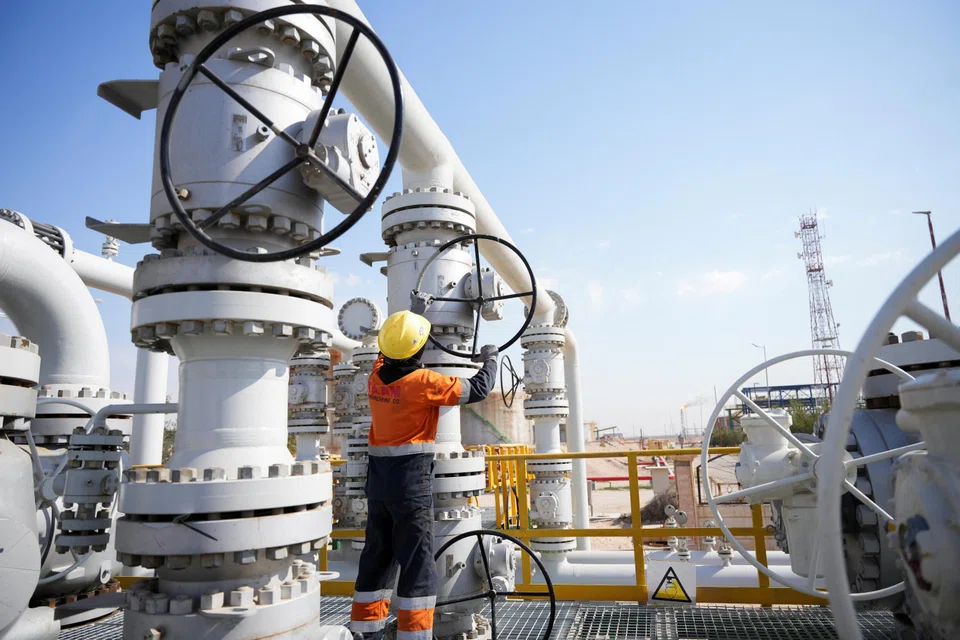
Coal producer Geo Energy Resources has benefited the most from the jump in the commodity’s prices.
Its shares were up about 14 per cent across that period, while upstream oil and gas company RH Petrogas shares have climbed about 10 per cent.
With global supply chains and fertiliser production also under threat, palm oil and agribusiness counters have also jumped.
Palm oil plantation company Kencana Agri was up about 46 per cent as at Thursday, while palm oil producers Bumitama Agri and First Resources’ shares rose about 18 per cent and 16 per cent, respectively.
Agribusiness company Indofood Agri was also up about 6 per cent.
Naturally, defence has also benefited, with ST Engineering shares up about 8 per cent. Concrete producer Pan-United Corporation similarly gained from defensive capital flows and increased about 6 per cent.
The resilient stocks which stood on their own
Many consumer staple names showed up in the top 15, as they might be considered defensive stocks with consumers still buying staples regardless of the situation.
DFI Retail , which owns food brand Meadows, convenience chain 7-Eleven and beauty and pharmacy chain Guardian in Asia, leapt about 17 per cent in this period.
The company said in its most recent earnings report that it responded to macroeconomic volatility and evolving consumer needs with a “stronger value proposition and enhanced omnichannel capabilities”. It also posted earnings that was an increase of 35 per cent from the previous financial year.
Similarly, PSC Corp , which supplies essential consumer provisions and packaging, posted a solid 6.25 per cent gain as investors sought out war-proof businesses.
Beyond retail staples, other traditional defensive sectors such as healthcare and real estate provided reliable safe harbours.
Dental provider Aoxin Q&M emerged as the second-highest gainer on the entire list, soaring 27.1 per cent, while real estate and hospitality player Bonvests Holdings added 5.6 per cent.
Semiconductor stock AEM also outperformed the broader market, with the market bullish on its standing amid the AI demand. It had recently reported strong demand from an AI/high-performance computing customer.
Aztech Global could also be supported by AI, with majority of the firm’s income derived from AI-driven Internet-of-Things segment.
Analysts though, flagged a near-term risk for the tech and semiconductor sector in the near term.
Morningstar, in a note on Wednesday, said: “Higher energy costs for AI data centres could slow AI infrastructure buildouts, while fabs in Taiwan and South Korea would face growing cost pressures from higher LNG (liquefied natural gas) prices.
Crude oil makes up 38 per cent of the energy needs for the US, home to most global AI data centres.”
“AI data centres are three to five times more power-hungry than regular counterparts, so prolonged crude price hikes could slow AI server buildouts and consequently AI chip demand,” it added, saying however that long-term drivers remain intact.
Another standout defying the geopolitical gloom is electric vehicle maker Nio , which has climbed 13.2 per cent.
Its gains are largely detached from Middle Eastern tensions, driven instead by its fourth-quarter swing into the black, recent delivery milestones and developments in its battery-swapping technology.
However, it could face headwinds, according to a CGS International note on Wednesday. Analyst Sera Chen expects its vehicle sales to come under pressure “given the competitive new energy vehicle market this year”.
Despite the resilient performance of these 15 counters, the broader market outlook remains cautious.
With the STI still down – despite previous predictions of it reaching 6,500 points by the end of the year – and global inflation concerns being stoked, investors face a complex trading environment in the weeks ahead.
Decoding Asia newsletter: your guide to navigating Asia in a new global order. Sign up here to get Decoding Asia newsletter. Delivered to your inbox. Free.
