


How discounts, deals are helping petrol players counter Cnergy’s low pump prices
Listed prices show gaps of more than S$1 a litre, but discount combinations can bring that down to cents
[SINGAPORE] Singapore’s retail petrol market may be facing renewed competitive pressure following the entry of Cnergy, but a full-blown price war – where players slash pump prices to match the newcomer – is unlikely, said observers.
Instead, incumbent operators appear to be leaning on “effective prices” – the final amount paid after discounts and rebates – to stay competitive and retain customers.
While headline pump prices between Cnergy and its rivals can differ by more than S$1 a litre, stacked discounts can narrow the gap to just a few cents.
Checks by The Business Times on price-comparison mobile app Price Kaki found that combining discounts at Shell petrol stations can bring down the price of 95-octane petrol from about S$3.47 a litre down to about S$2.53. Cnergy charges about S$2.40 a litre for its members buying the same grade of petrol.
Retailers such as Sinopec also often have sales that cut prices by as much as 29 per cent, bringing prices from about S$3.42 a litre to about S$2.43. The latest such sale was held on the weekend of Mar 20.
Listed prices unlikely to change
Singapore’s retail petrol market is characterised by high customer loyalty, said National University of Singapore economics lecturer Dr Wong Kwong-Yu.
Navigate Asia in
a new global order
Get the insights delivered to your inbox.
He cited a 2017 report by the Competition and Consumer Commission of Singapore (CCS) – then known as the Competition Commission of Singapore – which found that 58 per cent of respondents did not switch brands over five years, while nearly 80 per cent did not actively compare prices across competitors.
This entrenched loyalty reduces the incentive for incumbent operators to engage in a highly visible price war.
“If there is a price war, it is more likely to be in the form of discounts offered, rather than an apparent change in listed price,” said the economist.
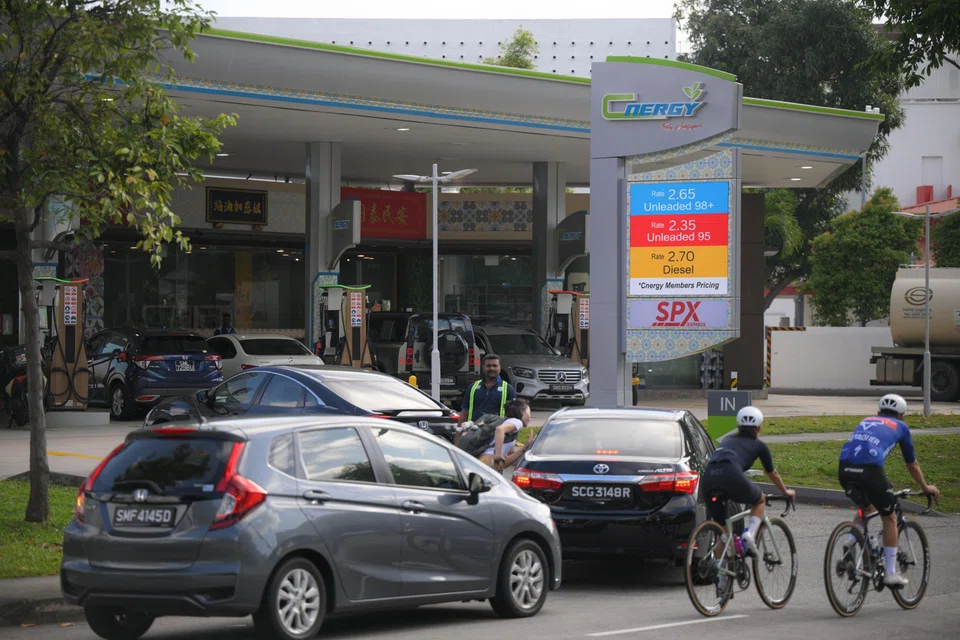
Cnergy’s ability to disrupt the broader market may also be limited by its relatively small network of three petrol stations. The long queues observed at its stations point more to capacity constraints than a widespread shift in consumer behaviour.
Thus, its impact on larger incumbents – which operate several dozen stations islandwide – is likely to remain contained for now.
Still, Dr Wong noted that Cnergy’s lower prices and the attention they have drawn could begin to nudge consumers to monitor and compare prices more actively.
“While Cnergy has only a few stations now, it could become a concern in the future if it manages to gain a foothold and expand,” he said. The new player plans to open a fourth outlet in Marsiling in 2027.
On whether Cnergy can influence the market despite its size, CCS said that station count alone does not determine competitive pressure.
“Various factors can affect consumers’ considerations in switching between suppliers, such as location and individual prices after discounts,” said the regulator.
When asked about potential adjustments to pricing strategies in light of new competition, a Shell spokesperson said that the company does not comment on competitors’ pricing strategies but highlighted its focus on delivering value through its established ecosystem.
“Shell continues to offer motorists and our private-hire partners a range of existing fuel savings and loyalty programmes,” said the spokesperson, pointing to its membership and partnerships with banks, Grab, Safra and HomeTeamNS.
Esso Singapore parent company, Aster – itself a subsidiary of Indonesia’s Chandra Asri Group – did not respond to media queries.
A missing Kaki
When asked if the “listed pump price” is still meaningful when most drivers use discounts, Melvin Yong, president of the Consumers Association of Singapore, said that the listed pump price “is but one metric” that consumers can use to compare fuel prices objectively.
“However, as it is the industry norm for fuel retailers to offer different promotions in collaboration with their partners, the Price Kaki mobile app allows users to create their fuel profile.”
The app, which was launched by CCS to encourage price transparency across retailers, makes it easy for users to calculate the effective price per litre they would pay after factoring in available discounts offered by retailers and their partners, he added.
Despite the government’s push for digital transparency, Cnergy remains absent from the Price Kaki app. Instead, drivers have to visit its petrol stations to know the latest prices.
Cnergy declined to comment on its absence from the government-backed platform.
Ultimately, a disruptor like Cnergy does not necessarily need a massive market share to keep prices in check, said Dr Wong.
He drew a parallel to the aviation industry, noting that the mere presence of low-cost carriers often leads to lower overall fares on specific routes.
“The presence of a maverick like Cnergy can keep the pressure on the pricing of competitors,” he added.
Decoding Asia newsletter: your guide to navigating Asia in a new global order. Sign up here to get Decoding Asia newsletter. Delivered to your inbox. Free.
