Rohan Rajpal: From Open-Source Code to a Bootstrapped AI Commerce Engine
The most valuable software is often the software that disappears. It takes a hard technical problem, the kind that normally demands an expert to operate, and folds it into something an ordinary person can use without thinking about what sits underneath. That collapse of complexity into simplicity is deceptively difficult to engineer, and most systems never manage it. The ones that do tend to share an author who cared more about the person at the other end than about the sophistication of the machine.
Rohan Rajpal has spent his career building that kind of software. Today, as Co-Founder and Chief Technology Officer of Spur, an agentic B2C CRM that does marketing and support across WhatsApp, Instagram, Facebook, live chat and email, he runs the engineering behind a system that more than 1,000 brands in over 70 countries have used to market to and support their customers, and that handles more than 72 million conversations a year. The principle he brought with him from his first open-source contributions has not changed: the hardest part of a powerful system is making it usable by someone who could never have built it.
Built for People Who Could Not Build It Themselves
Mr. Rajpal’s instinct for engineering showed early. As a schoolboy, he built custom Android ROMs, and by the time he was studying Computer Science at IIIT-Delhi he was contributing to software used by millions. Through Google Summer of Code he redesigned parts of the VLC media player for VideoLAN, rewriting production interfaces in Qt and C++ so that one of the world’s most downloaded media players felt more fluid and intuitive for everyday users.
That focus on the end user, not the machine, ran through his research as well. He spent nearly two years as an undergraduate researcher in IIIT-Delhi’s Precog lab, which studies computational social science, privacy and security, where he built the lab’s data-collection pipeline on the Elastic stack. He worked there on a project with Kiran Garimella, then a postdoctoral researcher at MIT, and he credits the lab’s habit of asking what a result could actually change, rather than how sophisticated the analysis was, for the speed with which he later built things that mattered.
Rebuilding the Backend of a Travel-Tech Platform
After internships at Expedia Group, where he built Spark microservices in Scala, and at a medical-imaging VR startup, his first full-time engineering role was at Headout, the venture-backed platform for travel experiences, in Bengaluru. He took on the backend that ran the company’s three core services, written in Kotlin, Java and Spring Boot, and in the six months he was there he carried out a refactor that the company’s engineering blog later published under the title Increasing developer productivity by 1,100%.
Hot-swapping compiled code cut the feedback loop for a single change from about 120 seconds to 10. Moving container builds to Jib cut continuous-integration time from 10 minutes to 3. API documentation was generated from the code itself instead of maintained by hand, and more than 20 redundant configuration files were retired as the stack moved to Kotlin.
The lesson he took from it is the one that runs through everything he has built since: the speed at which a team can see the result of a change decides how much it dares to try. “For a developer, an easy-to-use and fast feedback setup is the goal,” he explains. “The faster one can see the output of their code, the more they can experiment and release software faster.”
A Bot 150,000 People Came to Rely On
The pattern Mr. Rajpal had identified became impossible to miss during India’s COVID-19 vaccine shortage in 2021, when appointment slots on the government’s CoWIN portal appeared and vanished faster than anyone could refresh the page, and people were spending whole days watching for one. On 4 May 2021, he launched a Telegram bot that watched the portal for them: a user entered a PIN code, and the bot sent a notification the moment a nearby slot opened. He built the notification system on Python, Redis and PostgreSQL so that it could push alerts to a growing crowd in real time, and his co-founder, Royal Tomar, took it to the people who needed it.
It was built for friends, and within weeks it helped tens of thousands of Indians find vaccination slots. A month after launch it had 100,000 users, with 3,000 to 4,000 more joining every day, and by the end of June it had passed 150,000. “Every day we get messages from people thanking me that they got their vaccine jab,” Mr. Rajpal wrote at the time. Coverage followed in national outlets: the Times of India, NDTV, News18, Mid-day and the Economic Times, and a Press Trust of India report carried across the country. The work won both founders IIIT-Delhi’s Dean’s Award for Innovation, Research and Development.
“This is by far the most impactful project we have ever worked on,” Mr. Rajpal told reporters at the time, and he was clear about where it came from. “I didn’t make the bot because someone told me to. None of my peers was doing it. The sole reason for me to do this was to create an impact,” he wrote. “This might seem like a random project that caught traction, but it was the skills I learned during Precog, the network I made, and the countless hours I spent on the research project that helped me build things like these so quickly.”
The lesson stayed with him. “It is interesting that simple solutions are often the ones that scale the most,” he said, “though scaling them is the hardest.”
From a Vaccine Bot to Conversational Commerce
The bot pointed at a larger thread Mr. Rajpal would follow for years: conversations, and the businesses that depend on them. A string of ventures followed, each carrying a lesson forward. One of them, SevaShop, which he built with Mr. Tomar so that a salon or a car workshop could open an online store in fifteen seconds, won InOut 7.0, then India’s largest hackathon, and earned a place in Devfolio’s Build India Fellowship with a $5,000 grant, and was selected for IIT Madras’s I-NCUBATE programme.
What finally settled the direction was a paying customer. A seller who had used the vaccine bot asked the two to build something similar to sell his own products over chat, and was willing to pay for it. That was the validation he had been chasing: a real problem, a real customer, and something he could build.
It became Spur, and five years on that first customer is still on it. He and Mr. Tomar shipped it to the Shopify App Store on 5 September 2022. Today the listing carries a 5.0 rating across more than 115 reviews.
The Architecture Behind the Simplicity
As Spur’s Chief Technology Officer, Mr. Rajpal designed a platform whose entire purpose is to let non-technical brand owners run sophisticated automation by describing what they want in plain language. One agent, with the same intelligence behind it on every channel, runs across WhatsApp, Instagram, Facebook, live chat and email.
When a brand installs Spur the agent pulls the store’s full Shopify context, down to live inventory, SKUs and every variant, and once a shopper identifies themselves it can see their order history, an open return or an active subscription, so it answers as if it already knows them.
Underneath sits a customer data platform he built that segments millions of shoppers into cohorts for campaigns, and a retrieval pipeline that answers questions while carrying out respective actions, such as creating order, fetching order details, helping with refunds or updating a customer’s profile. The agent now handles roughly 70% of conversations end to end and routes the rest to a human, learning from each handover so it can take a similar query alone the next time.
“The dumbest thing about current AI customer support is that it has zero context about the customer itself,” he says. His method is a formula: “Just give it as much context of the customer, and give it context of the company itself. Then it automatically gets better as an agent.” Context, in his framing, is what gets the agent through today’s conversation, and while the models underneath keep improving, the harnesses around them have not. The harder property is whether it keeps getting better across the next 72 million conversations without losing what it already knew, which is why every handover to a human is fed back into the system. He treats the two as separate questions, what the agent knows and how well it can keep learning, and builds for both.
The system is being built to be fully agentic. A merchant can ask for three campaigns at once, one for new customers, one for one-time buyers and one for repeat buyers, and the platform assembles the segments, writes a different message for each, and sends them. Two pieces make that possible. Spur Sidekick lets a brand operate the product by asking rather than clicking through it. And through the Model Context Protocol, the emerging standard that lets an AI agent work across outside tools, a brand can run Spur from inside software it already uses, such as Claude or ChatGPT, without opening the platform at all.
Spur’s MCP server exposes more than 40 tools, from template approval to broadcast analytics, and a tenth of the company’s customers already run their campaigns and pull their daily figures that way.
Every one of those choices is measured against a single number. Spur reports the revenue each automation earns, a figure the team calls Spur Attributed Value, so a brand sees what the system made rather than how many messages it sent. Being early to Meta’s own platform changes is part of the same job. When Meta began letting brands bid on WhatsApp marketing messages by naming the most they will pay for one delivered message, Spur was among the first partners to offer it, and the ethnic-wear label Tara C Tara used it to lift delivery of a festive offer from 15% to 68% of its list, for 83 orders and revenue at 15 times its messaging cost, while the average price it paid stayed below the standard rate. In 2026, Mr. Rajpal and his engineering team rebuilt the platform from the ground up so that it could carry larger customers and self-serve growth without strain.
The line back to his earliest work is direct. A system that lets a shop owner run AI-driven marketing by describing it in a sentence is solving the same problem as a media player rebuilt to feel intuitive, a backend rebuilt so engineers see their changes in ten seconds, or a bot that turned a broken government portal into a single notification: take something complex and make it usable by someone who should not have to understand what sits beneath it.
Bootstrapped by Design
Mr. Rajpal built Spur without venture capital, treating customer revenue as the company’s only funding line while competitors operated on millions. He frames the constraint as an advantage.
“When you bootstrap, you find channels with zero or negligible customer acquisition cost,” he said. “You can never do that with VC money.” The company reached brands across more than 70 countries without spending on marketing, replacing an advertising budget with teaching.
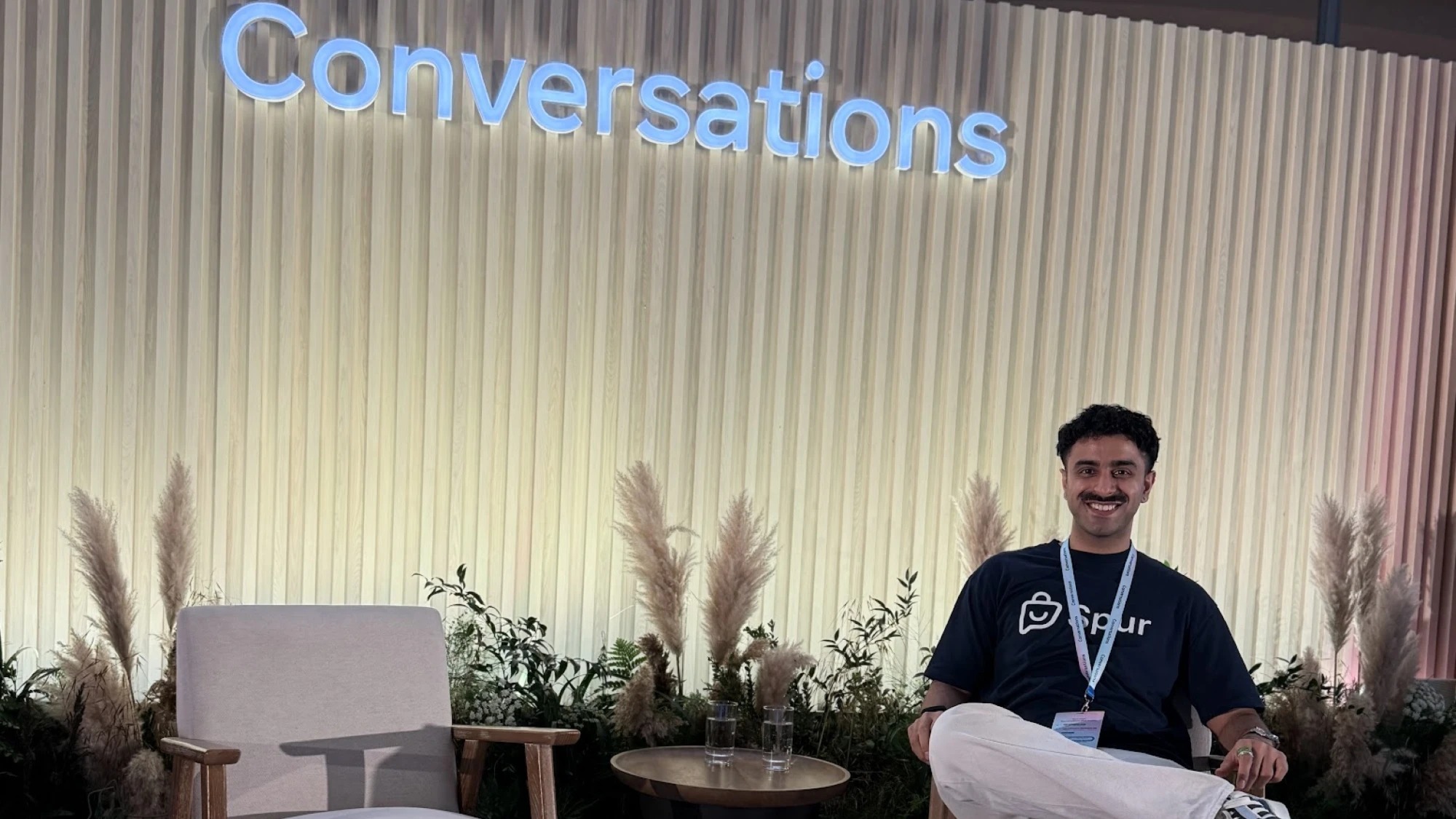
As Meta Business Partners, Mr. Rajpal and his co-founder have hosted four events with Meta, three of them at Meta’s offices in Gurgaon, Mumbai and Bengaluru; were given a partner booth at the WhatsApp Business Summit in Bengaluru in July 2026; and were among the select partners invited to Meta Conversations in London in June 2026, Meta’s biggest business-messaging event.
When Meta published Golden Tree, a Slovenian wellness brand and Spur customer, as an official WhatsApp success story, the experiment behind it had been designed by Spur and run on its platform: 20,000 customers split into two groups, order notifications sent before any promotion, and a return on ad spend of 2.5x against 1.36x for marketing alone.

In December 2023, Spur was one of the early-stage startups handpicked for Prime Video’s Mission Start Ab, a competition series produced by Endemol Shine India with the Office of the Principal Scientific Adviser to the Government of India, in which investors Kunal Bahl of Titan Capital, Anisha Singh of She Capital and Manish Chowdhary of Wow Skin Science put the founders through a season of challenges for a shot at investment. It was the show that brought Spur its first hires.
Mr. Rajpal no longer describes what he built as ordinary software. “We don’t even call ourselves a SaaS company now,” he said. “We call ourselves an AI company.” He is equally clear about who wins from here: “The best one will be the company that performs the best in research and builds the best AI harness around the current solutions we have.” The framing has changed. The underlying problem, the one that runs from the VLC player through a vaccine bot to an agentic commerce platform, has not: build something powerful, then make it simple enough that the person who needs it most can use it without asking for help.